It’s been almost four years since we visited Iceland and a
couple of events combined recently to start the creation of a memory
quilt.
- A serious clean of my sewing room looking for a missing pattern turned up a package of goodies I brought back from Iceland but had never opened. A bag of Icelandic sheep fleece in various colours, rocks, shells, buttons from animal bones and some fish leather were just asking to become part of a project.
- I took two workshops on weaving that has me seeing yarn in a whole new way; not the tedious boredom of knitting or crocheting, but creating fabric aka quilt squares. Ordering yarn online had me finding Custom Woolen Mills Lopi Yarn – spun in the fashion of the Icelandic yarn that I had seen but never had a reason to purchase. And looking a bit further found a Canadian distributor of the actual Icelandic Sheep Yarn.
The art quilter rebel in me started playing with the fibres
I had to create blocks for a scrapbook like reminder of the great times we had
visiting Iceland in June and July 2012.
Not smooth and delicate like I learned at the workshops, but rough and
textural like I remembered the landscapes of Iceland.
Lupins


When we came home, I found
lupin seeds to plant in our yard to join our very successful almost weed
Snow in the Mountain. I was also
reminded of this story when we were on the South Island of New Zealand in 2015,
where the dominant “wildflower” is also lupin – apparently seeded by a farmer’s
wife on her way from home to town to brighten up the landscape (most natural
plants have a small white flower). The
problem in New Zealand is that it loves to grow on the rocky river banks and
provides cover for the predators (evil possums introduced from Australia) of
the flightless native birds.
My lupin is silk ribbon embroidery on a block of Icelandic
Lopi and Western Canadian sheep/alpaca wool.
Like the Icelandic lupins, you’ll find hints of purple everywhere you
look on the rest of the quilt.
Finger Weaving


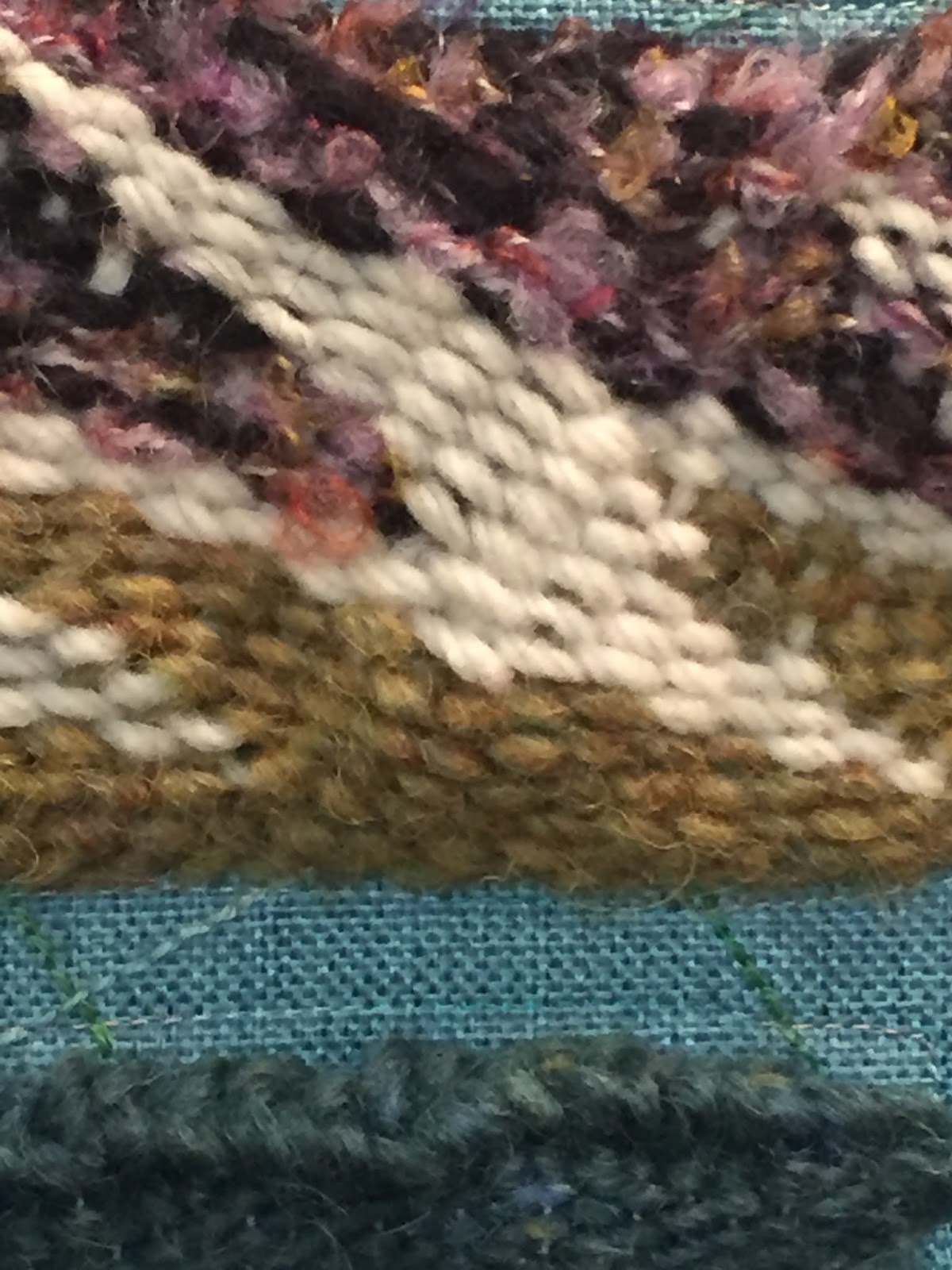

I created two rectangular blocks of fingerweaving in the
style of the traditional Metis sash, but with Icelandic Lopi to give a sense of
the landscape. The one, a lightening
pattern with accent of purple and the other with a deliberate emphasis of the
natural curving of a fingerwoven sash if you aren’t careful of the tension.
The Icelandic Sheep wool is not soft but almost prickly. The two layers, one providing warmth and the
other waterproofness, are ideally suited for the climate. As I was weaving these, I was thinking about
the comment of my B&B hostess who was from Mongolia that her country also
created fingerwoven sashes. I suspect
that in Iceland, too, there was some type of weaving with their wool to create
fabric. I also embellished the one with buttons made of bones.
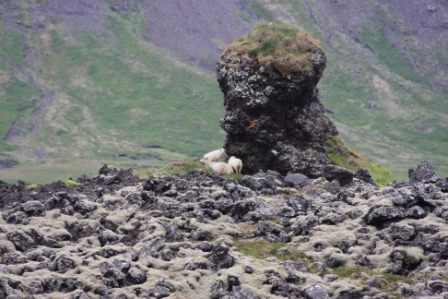 |
| Icelandic Sheep came with the first settlers in 900 or so. Very hardy and the wool makes great warm garments. |
Aurora (Northern
Lights)


We didn’t see the northern lights in Iceland as we were
there around the Solstice when daylight hours were at their maximum. Instead, I
let my imagination create a dark winter night with sparkles of light crossing
the sky. More buttons decorate the sky.
Glaciers and Lava
Flow

Even though we visited in late June, snow remained and there
were places that we were hiking on it.
Many of the mountains were home to glaciers. Apparently, each volcano has a characteristic
type of lava and our guides were able to tell us which bit of rock came from
which volcanic erruption. This square, woven simply
of Alberta sheep wool with a subtle glint from machine embroidery thread, was
embellished with a selection of bits of lava that I collected, quite frankly,
for their colour and texture.
Bryn (Landmannalaugar
to Skogar)

I still think of this multi day hike and of our guide, Bryn, who shepherded me through a day that challenged my physical as well as mental abilities. This square is my tribute to a patient and expert guide who believed I could do it. I have a picture of me behind Bryn heading out the next day along the snow toward the ocean (about 20 km away). My view was of his yellow, handknit sweater leading the way. Since then, I’ve had the pleasure of traveling with other guides who share their passion for their home with a belief that any trek is possible, one step at a time.
 |
| Bryn and the rest of our group. Somehow it was gourmet meals despite some very basic accommodations. |
 |
| The photo which inspired the weaving. |
Bryn's yellow sweater is Canadian Lopi style and the white is spun on a 19th century mulespinner (yes, that's the name of the type of machine). Icelandic Lopi for the ocean in the distance. I played with many ways to make fringes on the bottom with a mixture of wool and alpaca. For embelishment, some shells and bits of lava.
The Textures of
Iceland


 |
| Here's the seaweed on it's beach. Surprisingly little change in colour or texture in four years. |
The central panel combines Icelandic fleece in the blues, greens, greys, blacks and whites of the central highlands. In my mind was our second guide, Ari, lying on the boulders of a lava field from the 1800s, trying to convince us how comfortable the moss covered rocks were. Yes, they looked soft and fluffy, but the cover was only millimetres thick. I added a bit of commercial yarn as well as some Alberta wool and alpaca to create the scene. The embellishment is a strand of seaweed, still subtle, from a beach we discovered on one of the stops along the north side of the island.
 |
| Ari, lying on the moss covered boulders from the eruption that "caused the French Revolution" |
Beachcombing

One of the beaches we spent time on was to allow us to look
out toward the Arctic Circle and the small island of Grimsey. Too far to see, but it gives Iceland the
claim that it is one of the countries with land above 66 degrees. I was less impressed by that (hey, in Canada,
we can drive to Inuvik above 68 degrees) than the chance to go
beachcombing. Some shells and this great
piece of plant fibre just asking to be part of something creative were tucked
into my backpack. Wrapped around the
stem is some fish leather (pleather) found while exploring the shopping
district of Reykjavik. Pleather in
Canada is an exceedingly rare and expensive item you find embellishing high end
clothing items. In Reykjavik, this was
in a hardware/sporting goods store that had some craft items (think any small town store that has a bit of everything), including shelves
of fish leather sorted by type of fish and colour of dye. No wool in this store – all things wool were
to be found in the Handknitting Association of Iceland store around the corner.
Background


In keeping with the roughness of the blocks, I created the
background from burlap which was stitched with thick cotton Eleganza Perle to a
firm interfacing to provide support for the weight of the blocks and
embellishments. Of course, there is a
trail of lupins. One final embellishment
is a knitting row marker hand made and found at the Handknitting Association,
where all things knitting were available.
If you're interested in reading about our time in Iceland, I wrote a blog post here about a year later. Check out the photos I posted on Facebook just after we returned home.
If you're interested in reading about our time in Iceland, I wrote a blog post here about a year later. Check out the photos I posted on Facebook just after we returned home.


