Friday, 24 April 2015

Journal Quilt: Last five squares complete

The last five squares are complete and four others have had some additions made.  I’ve had the luxury of using computer, sewing machine, fabric paint, and all the other bits of interesting stuff in my stash, so these squares are a bit less rugged than some of the others.  After the backing is added, there will be some final embellishment (sort of like the almost last fitting of a custom made dress), but I’m really enjoying the look of this year long project.

N 40.22.33 E 49.51.08 Azerbaijan

We only spent a few days in Azerbaijan as we raced across the desert to try and book a ferry crossing of the Caspian Sea.  Calypso, our trusty truck, only had a visa of 72 hours before being fenced in at the dock in Baku.  Best fun was exploring the mud craters just outside the city and I decided that I would wait until I could print a photo of one of them on fabric before creating Azerbaijan’s square. I also created two “flames”, the symbol everywhere of Azerbaijan’s oil industry.  I found it fascinating to discover that the pattern we call “paisley” in the west is called “flame” along the silk road.  The beautiful lambs’ wool scarf I bought in the old city of Baku is patterned with these paisley flames as well and was what I wore with my basic black dress for Christmas dinner in Christchurch.  I was fascinated by this coin,  that on first look, appears so similar to the Canadian Toonie.


S 46.55.35 E 167.46.48 Stewart Island, New Zealand

My muttonbird scrub leaves arrived home in a parcel rather than being mailed and I had to coat them with some matte medium so that I could stitch them to the quilt.  This is probably going to be the most fragile square of the entire quilt.  It brings a big smile when I think about the day we watched a kiwi for the longest time then wandered through Ulva Island checking out the other birds and plants that thrive there.  I harvested two leaves, then used the ink of the Miru tree to write my message.  Christy, our guide smilingly autographed it, AND posed for a photo.  Then, the local postmaster agreed to hand cancel the leaf after convincing me that I didn’t need to pay the entire cost of postage, that a ten cent stamp would give the idea.


N 22.17.59 E 114.10.03 Hong Kong (retail therapy)

At the beginning of our trip, I had thought that one square might be created from labels I could liberate from garments I would purchase along our journey.  What I found was that the garments I purchased were handmade and didn’t come with a label!  And to be honest, I was more focused on fabric in all its shapes, sizes and colour rather than mundane clothes.

However, our stay in Hong Kong was in a very elegant hotel along Canton Road in Kowloon; where all the western fashion designers have their flagship stores to attract the wealthy (primarily Chinese) visitors to Hong Kong.  I had a great morning wandering the street and taking photos of the shops and was attracted to the colours of one dress in the H&M window.  An hour later, I had a selection of tops that were a little different but also very wearable back home in Northern Alberta.  Each item had a multitude of labels with information in all the languages that this international store does business.  And what I found so fascinating on arriving home is that the colours that were so prevalent in Hong Kong are not the fashion colours I am seeing in Canada – perhaps I am a year ahead?

I used the garment labels to create a fabric square (something I could not have done on the road without sewing machine and stabilizer), then added coins from Hong Kong, Macao and an ancient Chinese coin from the night market.  Just for good measure, I added the label from our bottled water in the hotel room.


N 53.34.06 W 113.31.26 Edmonton (things will wear out)

This photo of my boots was taken while I sat on the dock waiting for transportation to Limbang (and a hot shower and clean clothes) in Sabah, Borneo.  The two days of heat, humidity and muddy, technical hiking in the tropical rainforest had been fascinating but exhausting.  For some weeks, I had thought that perhaps it would be time to replace my faithful boots (bought in 2008) when we arrived in Edmonton.  There were areas on the inside that were frayed and I was starting to get blisters.  However, as I sat on the dock, I realized the question was not “should I” but “will they survive until we get to Edmonton in three weeks”.  The leather had split on the folds, the stitching holding the heel to the rest of the boot had rotted and the sole was starting to separate from the rest of the boot.  I did not dare wash the boots as it was probably the mud that was holding everything together. My only other choice of footwear was sandals or pretty yellow dressup shoes. Yes, we had become experts in traveling light.

I have many great memories of where these boots have taken me, but I left them at Campers Village in Edmonton when I bought another pair of boots, taking only one shoe lace as a reminder.

On reflection, what fascinates me is how little of what I took on our year of travel did wear out, considering that I followed the suggestion to only bring old, comfortable items that you wouldn’t mind losing or staining or breaking.  I’ve included a few other things that also wore out:
The light blue Canadian flag material was wrapped around the handle of my backpack and took a lot of wear and tear when carrying the bag rather than using the backpack straps.
The purple ruffle flower is from my purple swimsuit, worn regularly since 2006 – even Speedo fabric will eventually start to disintegrate - and it was last worn on the Franklin River under a wetsuit.
The center of the flower is the metal disc from my thimble that finally needed to be replaced in Nelson, New Zealand after more than ten years of use.
The rather well used Canadian flag pin lived on my hat for the entire trip. It was actually from a package of pins I got from Ollie Currie (Swim Alberta) in 2010 after Peace River hosted the Alberta Summer Games.

For the record, the only other things that wore out were:
Our travelling coffee pot was replaced in Turkey, given away in Malaysia and replaced again in New Zealand.
My water bottle broke in Uzbekistan, was replaced in China, wore out and was replaced in Christchurch.
My smartphone became very forgetful and grumpy but limped through to Kolkata where I purchased a small notebook computer, then finally died two weeks before we got home.  It just had had too much of unpredictable power surges.


N 56.11.18 W 117.35.56 Grimshaw (Home Again)

When I was creating the first square on the quilt, a pieced maple leaf block, I thought that perhaps the final block would be another maple leaf motif.  On reflection, though, my home does not have native maple trees, which only grow in Ontario and Quebec.  Northern Alberta trees are poplar and spruce, our provincial flower which grows along the paths we walk is the Alberta Wild Rose, and the most successful plant in my yard is Snow in the Mountain (a pretty variegated leaved plant that some consider a weed).  My coming home square uses the silk that travelled with me for the year and is featured in some of the other squares but it is painted with fabric paint that stayed home to become the Wild Roses.  The background square is a photo I took two years ago of my Snow in the Mountain gloriously taking over a flower bed to the exclusion of the most determined weeds.  The stem of the roses is sari silk yarn that I bought on impulse online some years ago.


As I was creating squares on the road, there were some things that I couldn’t complete with the small sewing kit I was carrying.  I’ve also finished four of those squares.  I suspect that there are a few more squares that will get a bit of extra additions as I sit and look at them. The squares that have objects to be added like shells or stones will need to wait for the final finishing touches.

N 41.41.45 E 44.48.44 Tblisi, Georgia

The hand woven and hand embroidered square has been patiently waiting to have some machine stitching for the Georgian Cross.  Hand stitching  just disappeared into the thick cotton threads.  It’s hard to see in the photo, but the square now has the outline of both St. George’s Cross (for the state) and St. Ninian’s Cross (symbolizing the religion of Georgia)


N 27.19.56 E 88.36.48 Gangtok (Sikkim), India

The fabric was from the market in Gangtok and the frame of the spider web is hemp from a shirt I bought at the market in Kolkata, but the threads themselves needed to be some of the glittery almost transparent shimmer thread that I’ve finally added to the square.  I still remember how beautiful and dramatic the spider webs were as we travelled through Asia.  A photo I found of my first encounter with leeches when we explored the zoo in Gangtok was also the hint I needed of where some lovely fabric and a beautiful scarf came from.


N 15.52.48 E 108.20.22 Hoi-An, Vietnam

All this square needed was a bit of machine stitching with pale pink thread to finish it off.


S 43.44.15 E 170.06.03 Mt Cook National Park, New Zealand

I’ve added the foot fleece clouds to the background.  This very experienced foot fleece has traveled from New Zealand home in 2009, then to Scotland, Iceland, Haida Gwaii, then on our year of travel.  The last bit of this package got wet in a backpack on one of our last treks in Borneo and has even been partly wet felted.


Next is to take the backing fabric I painted on the back sidewalk of our hostel in Perth, add some words and memories, then sandwich everything together.  Quilting is going to be a combination of machine and hand and in the spirit of more is better, of course there will be some final bling to be added.  Stay tuned.


Wednesday, 8 April 2015

Things I learned while travelling III: Always listen to your public health nurse...

... but some things are more important than others, use common sense.

During our year of travel, I certainly learned that some pieces of advice are more important than others.  It was interesting to talk with other travellers about what sorts of advice they had picked up along the way and even though they all came from similar (first world) backgrounds what others decided was important often varied widely from what I had come to believe was true. I’ve learned to thoughtfully compromise on some things in order to experience the local culture but also to be firm about what seems to be most important.

Here are some of the things that I still think are absolutely essential if you are going to do long term travel that involves camping, hostelling, homestays, or travel to developing countries.

Pre trip planning

Immunizations including routine updates and anything recommended.  I wondered if I had over prepared when we included rabies vaccines in our list, but we were definitely in areas where there was the potential for bites AND where rapid treatment was not available.  I had interesting conversations with fellow travellers who had extensive experience with safaris in Africa or adventure travelling in areas of high incidence of rabies who had never thought this might be necessary.
Malaria medication if it is recommended.  Bring medications from your home country and don’t assume that you can buy the correct medication along the way. Bring extra to allow for a change of plans.  I discovered, for example, that I could not get Malarone anywhere in Malaysian Borneo (despite the high risk for malaria anywhere in the interior) and that only Doxycycline was available.
I brought a variety of prescription and non prescription medications to deal with common diseases as well as basic bandaging materials.  I used very little, but would definitely carry the same types of things again.  A good reference is the medical chapter in Lonely Planet's “Trekking the Nepal Himalaya”, even if it is dated.
Travel medical insurance that will cover you if you get sick or injured in the locations you are going to be and doing the things that you are doing.  Even if you never need to use the insurance, it provides peace of mind.  One of our fellow travellers had found the hard way why this was important.  He and his partner had the standard basic insurance, but when she was diagnosed with dengue and then hospitalized, they discovered their policy didn’t cover the hospitalization costs in an almost western style hospital nor did it cover trip cancellation.  She had no choice but to fly home.

Food and Water Precautions

This was definitely an area where using common sense played a large part. The common reminder “well cooked, served hot, washed with water you know is clean, comes from a bottle...or forget it” needed to be applied with some thought.
Travelling overland, we were responsible for many of our own meals – the purchasing, the preparing, and the ensuring that everything was a clean as possible.  Handwashing was stressed as was proper washing of dishes.  But, the disinfectant of choice was Dettol antibacterial liquid, primarily because the company has a very effective marketing arm, not only in Asia but also in the UK where our guides came from.  I felt this wasn’t something I could compromise on, even if others were ok with this so on our last trip to a western type shopping mall in Turkey I purchased a large container of household bleach and extra large containers of alcohol hand sanitizer.  It helped that someone else on the trip supported this – as a veterinarian this was standard procedure in her practice.  But, always carry extra because there are some places that these things may not be available.  Alcohol hand sanitizer in China is a prime example.


Water I knew was clean also was a priority.  We carried reusable water bottles and filled from large commercial bottles we could purchase everywhere.  And we made sure that the bottles were washed and soaked in a bleach solution on a regular basis.  Or we drank hot drinks with water we had seen come to a boil.  Interestingly, in China you would see locals bringing large thermal jugs to work filled with water they had boiled at home.  Don’t assume that anything in a bottle is safe to drink – on arrival in Uzbekistan, our guide explained which brands of water were recommended as some of the other brands did not actually follow accepted standards.

Not only was Nescafe the only coffee available.
Nestle also provided safe drinking water
(as well as baby formula)

Well cooked and served hot was generally a good recommendation but I will confess to using common sense when it came to ice cream and fresh fruits and vegetables.  How can one refuse beautiful homemade ice cream in a village in Kyrgyzstan after you have been smiling and visiting with everybody and enjoying the local meal that had been prepared before our eyes?  Would I have refused if I had known ahead of time that the dishes were being washed outside the door in a bucket of water from the community pump?  Or how to refuse the opportunity to try fruits and vegetables picked right off the tree?  I well remember stopping for lunch at a small town, finding a small local open air restaurant and negotiating fried rice for our meal. The chef began washing and chopping things and sent a child out to get the neighbour to pick some vegetables from the garden.  It was delicious, well cooked and served hot, even if the water probably wasn’t clean enough to drink.

Watching this wee girl eat her ice cream without spilling a drop
was just too irresistable...


local open air restaurant.  Bottled water, disposable cups,
clean table.  Plus we watched the food being cooked from
scratch.
We encountered a few places where it probably wasn’t safe to eat and we tried to always have some packaged snacks for such occasions.  The day we stopped at a market on a muddy street where you could see that the water for washing reusable dishes was runoff from the rice paddies that was being used by humans and animals alike AND that the cooked market food was precooked and sitting in the open....  We ate chocolate bars and bottled water and were not sick the next day unlike some of our fellow travellers.  On the other hand, we also stayed in a community where we were the only western tourists (possibly this year as we were well off the beaten path) and there was only one place to eat.  We watched very carefully what locals were eating and tried hard to not watch how the dishes were being washed outside in large bowls of water.  Common sense says you can’t not eat for two days.
Being aware of food and water precautions doesn’t stop when you are travelling in a first world country.  In the same way that we hear of food borne outbreaks in Canada or of the need to filter or treat water when backpacking in the mountains,  common sense needs to be used anywhere you travel.  We were quite surprised on one outback tour where the things we had come to expect in developing countries were not available.  Water still needs to be treated if it is coming from a source that is untested, particularly if it is being used by humans and animals.  You need to maintain cleanliness of your cooking facilities and hand sanitizer needs to be available if running water and soap is not.


Beautiful campsite in the outback.  More basic than many we
used in central Asia.

Bugs and Beasties and Things that Nibble at you (Insect Precautions)

Mosquitoes carrying malaria or dengue aren’t the only thing to be aware of when it comes to insects.  We also became well acquainted with the local leeches, ticks, scorpions, spiders, and other interesting beasties.  I found it fascinating learning how to deal with these creatures from guides as well as fellow travellers.


This lizard got some emergency outpatient tick removal surgery.

We took antimalarial medication in risk areas and were very conscientious about insect repellent – DEET 30% from Canada then from Thailand.  It was difficult to find DEET repellent in Australia so we postponed purchasing any, thinking it would be easy to find in Indonesia or Malaysia.  NEVER assume.  All that was available in Indonesia were “natural” repellants and in Malaysia we finally found some “family strength” (14%) Off (and only in pharmacies).  The reason was that in these two countries, the accepted procedure is to spray your bedroom with a strong pesticide rather than put anything on your skin.
We had to make a lot of compromises about insect precautions based on the realities of the situation.  We didn’t carry permethrin treated nets (as is recommended by public health) for space reasons.  There were a couple of places where they would have genuinely been appropriate – sleeping in thatched rooms that were obviously open to the night air where the “bed nets” provided had huge holes.  Instead we liberally applied insect repellent and hoped for the best.  On the other hand, we had one night in a “basic” camp in the interior of Malaysian Borneo, where our sleeping platforms had good quality netting available.

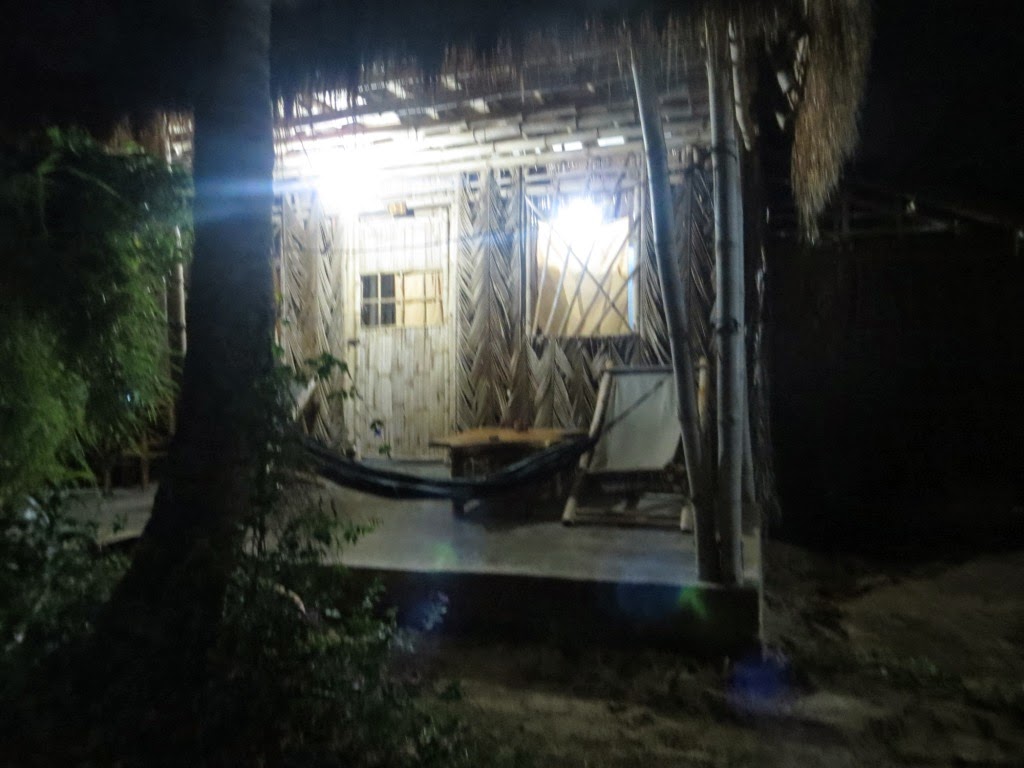
Scenic jungle resort in Vietnam.  Thatched walls and roof
with decorative (not functional) bed netting.  Rural area with
significant risk of malaria.  No choice but to apply insect repelant
and hope for the best.

View from our basic hostel at camp 5 in Mulu National Park.
Definitely in a malaria risk area.  Each sleeping space had
bed netting to totally enclose you.  A great sleep was had.
The other compromise we had to make was as we came to the end of our travels.  We carried enough Malarone (I thought) for all the areas we were travelling through where there was a risk of malaria.  However, as we arrived in Borneo, we were running short just as we were starting to travel through the probably highest risk area of the trip (rural, jungle, interior of the island).  Yes, we found a western style clinic with a doctor trained in Singapore and yes he was prepared to be as helpful as possible.  But Malaysian medical clinics only stock Doxycylcine and it was Chinese New Year and the GSK representative was on holiday so not available for a special purchase of Malarone.  So, with enough Doxycycline in hand to get us back to Canada, but not really wanting to take a medication that had some nasty side effects, it was time for some serious thinking.  From the malaria maps we could access on the internet, and a careful discussion with our guide (how far, exactly, from the coast was this river lodge?) we took the chance that in our last week we would be passing through malaria areas in the daytime and sleeping in lower risk areas.
It wasn’t all about mosquitoes.  Travelling through the deserts of central Asia we became used to the assorted flying insects that were attracted to our moisture.  Eau de DEET was applied faithfully in combination with sun screen.  When we got to Australia, I was able to find sandalwood essential oil which once again proved to be an essential deterrent to the tiny flies that wanted to infest my eyes, mouth, nose and ears.  Not anything that we think about in Canada, but something that I had learned from a guide on a previous trip to Australia.

It can’t be stressed to much that the best advice is to listen carefully to the advice given by others – a health professional who can give you evidenced based recommendations, your guide who has expertise about his local area, and even your fellow travellers who will share advice they got as well as experiences they have had.  Then filter it through your knowledge of what has worked for you and what your common sense says is important. Will I do things the same on another long term trip off the usual tourist trail?  Some things, yes.  Will I make changes on the basis of knowledge and experience?  Absolutely.

Wednesday, 1 April 2015

Things I’ve Learned While Travelling II: Pieces of Advice for Nico

Just before he left our group and headed out for another adventure, one of our crew, Nico, asked us all for one piece of advice that we would share with a new overland group.  Ours were “your sleeping bag can never be too warm” and “If you don’t carry Visa, carry lots of US dollars; Mastercard is not welcome worldwide”.

Your sleeping bag can never be too warm

This piece of advice came with a bit of smugness as we had slept comfortably through some cold and damp weather including bush camps at almost 5000 meters in Tibet.  Indeed I had only done the zipper up on the sleeping bag once and hadn’t yet resorted to tightening the hood around my head for the full mummy effect.

It helped that I was looking for sleeping gear in Alberta in outdoor stores that catered not only to the casual outdoor types like me, but also to the military as well as serious mountain climbing types.  In stock were bags rated to -20 and I could have special ordered much warmer ones.  My usual approach to selecting items worked well – go into Campers Village and stand around what I am interested in and look confused.  This time, a young man asked if he could help and when I explained what I was looking for – sleeping gear for a year of travel including spring in Central Asia and also Tibet and Nepal – he willingly explained all the merits of everything they had.  He chatted about his experiences with backpacking in Nepal – what he had taken and what he wished he had taken.  How can you do better than personal experience as a recommendation?

Quick lesson in sleeping bags:  Mummy or modified mummy bags are the only way to go.  Less bag to carry for the same level of warmth, less bag to need to warm up. There are boy bags and girl bags – for the same rating, women need more insulation, narrower shoulders and wider hips.  There are also left and right zippers – usually pick on the basis of what hand you are – left handed go for a right zipper so you can reach across your body to undo it.  However, if you are a couple and plan to zip together (which I find hard to imagine zipping together two mummy bags...) then you need one of each.  Synthetic vs down – I went for synthetic because it keeps you warmer when wet and I loved the explanation of my young man that when it got wet and muddy I could take it to the river, wash it out, hang it over a bush and it would dry as good as new.  We did have wet bags one night and it did keep me warm.

Add in a good air mattress to provide insulation between you and the ground.  Again, choose something that has insulation – synthetic if you suspect wet conditions.  How big and bulky depends on whether you are backpacking for days or travelling by truck like we did.

Sleeping  bag liner.  I went for a fleece liner because I like the fuzzy feel.  It was extra bulk, but worth it on those cold soggy nights.

Pillow.  Again personal preference.  It was actually my first purchase and I tried it out long before we left on our trip to make sure it was “just right”.  My recommendation here is definitely to try your pillow out before you go – everybody has their own personal definition of “just right”.

First night in Georgia and a balcony is the perfect place
to dry sleeping bags

Along the Karakorum Highway (China) and the sleeping
gear is still keeping us warm

Mastercard is NOT welcome everywhere

The pre-trip planning suggested we bring Visa and Mastercard credit cards plus US dollars.  Because our bank uses Mastercard and because it was going to be very complicated to get a Visa card we sort of ignored the suggestion.  The reality is that in most of Central Asia computer systems are iffy, ATMs are rare, and banks are not set up to deal with foreigners.  Most countries did not accept our debit cards to access our accounts and several did not accept Mastercard.  US dollars were accepted everywhere and there were money changers on every corner it seemed. Our bank in Canada was not helpful in dealing with the situation, primarily because as a small local institution they had no international knowledge.

Although I have some funny memories of sightseeing à la looking for an ATM that will work, it can’t be said too many times – don’t rely on credit or debit cards that work in your home country (and don’t believe the advice of your small town bank that Mastercard is welcome everywhere and of course all banks in the world are required to honour your debit card to access your accounts).  Carry US dollars and always have more in reserve than you think you need.  The recommendation was 1/3 of your budget and I would suggest closer to 50% to allow for emergencies and the occasional impulse purchase.

We're millionaires.  In Uzbek terms anyway.At the market,
US dollars were the way to go.

Here’s some other suggestions from our group (if you were there, you probably know who said what)

  • Get a blanket.
  • If there's western toilet, use it! Never trust a fart. (On the other hand, learning to use a squat toilet is a life changing experience)
  • Patience. 
  • Only drink your own bottled water. Stand up for yourself.
  • Do not be tempted by lots of snacks between meals. You don't need them, you fat bastards. 
  • Bring a very warm sleeping bag. 
  • I've never been on a truck that doesn't leak. 
  • Save your dollars, use ATM's if they are available. Always carry toilet paper. In China, two in one means three in one (sugared coffee). 
  • Make sure your hiking boots are good.
  • If you don't have Visa card, get cash! Cash is king, MasterCard sucks.
  • Don't bring loads of toiletries, you can buy is everywhere! 
  • If you're sitting in the back, wear your seatbelt. 
  • Bring a tolerant attitude. 
  • Bring a good -20* sleeping bag and good mat and pillow. And a water proof bag to keep it all dry. (Are you noticing the importance of warm dry sleeping bags)
  • With a positive attitude you can overcome everything. 
  • Don't take anybody else's advice.


Sunday, 22 March 2015

N 22.17.59 E 114.10.03 Hong Kong... and Home

When we were planning this year of travel, on impulse we decided to spend a few days in Hong Kong because we were landing there on the way from Kota Kinabalu to Vancouver.  I’m delighted that we did.  After a year of visiting some interesting and out of the way places and staying in tents, hostels and guest houses, we did a very upscale visit to Hong Kong.  Five star hotel on the Kowloon waterfront, some fascinating tours, some great food and a lot of pampering.

I had reread James Clavell’s novels (Tai Pan and Noble House) before arriving – but the huge reclamation projects in both Hong Kong/Kowloon and Macao meant that many of the places we were exploring didn’t exist before 1990. Hong Kong is still heavily centered on trade and finance and the deep Victoria harbour is still busy with ships of every description and many international companies send goods bound for China through Hong Kong because it gives a financial advantage.

People in Hong Kong describe their city (8 million people) as small by Chinese standards.  They are proud of their British heritage and despite the “One country two rules” slogan see that they are not part of China. We also took a day trip to Macao where the situation was similar but different.  Macao was always part of China, but administered by Portugal, so our guide had a different way of describing her city.  Both places are bilingual but with Cantonese being the language spoken, not Mandarin.  It’s clear that these cities are very affluent and look to the west for their way of living.  Streets are clean, infrastructure is first rate, and the crazy crowds of people we came to expect in Asian cities just weren’t there.  Even on our walking tour into the old part of Hong Kong, the crowds were like I have come to expect in a Canadian city.

Touristing in Hong Kong was different in a lot of ways.  No refreshing hikes through great scenery and no cute photos of animals, bugs and other beasties.  Instead there were colours, sights, textures and people to fascinate the senses.  Most interesting was the thick fog that permeated everything.  In the spring, the hot air meeting the cold gives fog so thick that you will see nearby buildings peeking through but not completely showing themselves.  The locals say that summer (May to October) is much better because it is sunny and hot (+35 not unusual) and humidity is close to 100%.  I’ll take the fog. There were a few things old but mostly new partly because we were in the reclaimed areas of town, but also because of the major destruction of Hong Kong during World War Two.

We thoroughly enjoyed the experience.  If we pass this way again, a few more days in Hong Kong will definitely be part of the plan. 


Fascinating lamp in our room

Dinner in the "not fancy" restaurant included flowers

...tablecloth and fancy setting for utensils

desert plate for those who could not decide.
Wee cup of mango pudding, something jellyish
and a warm sesame ball with chocolate

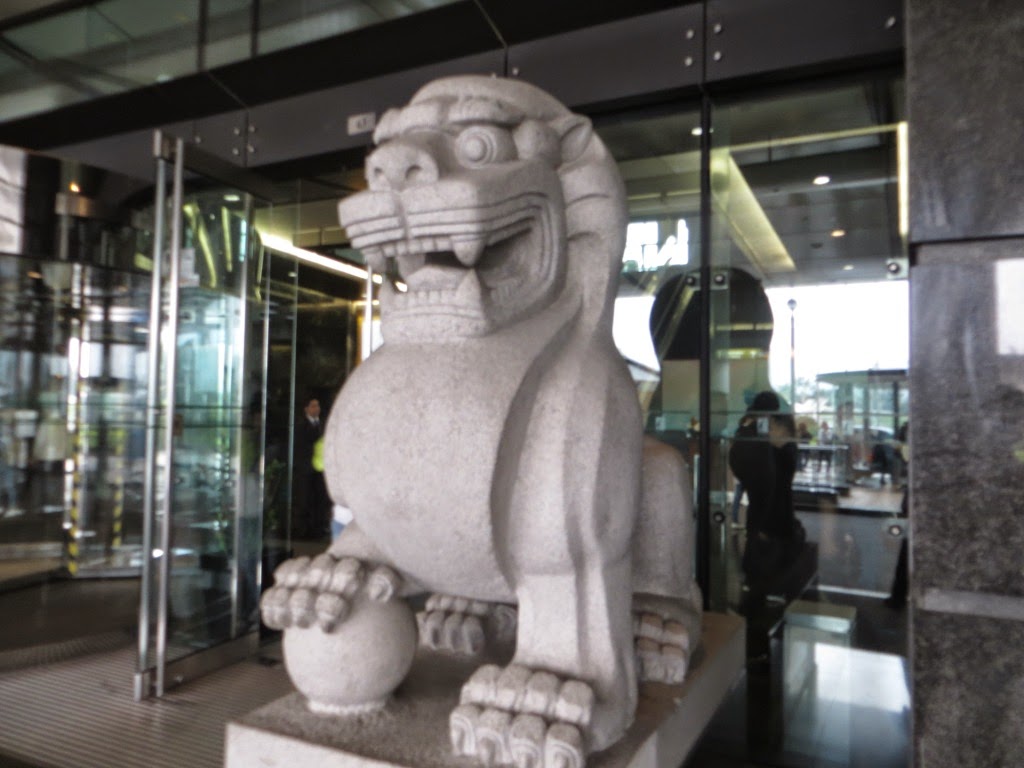
Very cool warriors guarding the lobby.  The concierges wore
suits and had big smiles, but looked like they could take care
of anything that might happen.

Kowloon skyline

"Beat the Banana" race for cancer research.
This fellow was using an Asian zumba sort of
approach to warm up the crowd


Find the banana


Tourist watching on the avenue of stars


Wherever this is water there will be fishermen
We spent a fascinating couple of hours at the History Museum. Sensory and information overload.
Hong Kong History Museum bathroom doors.


Pretty cool jewellery

Wedding procession.  At the front, are boxes of dowry -
just like we saw on Lombok.


And guardian dragons

Shadow puppet

The fellow who lost the Opium WAr (and thus allowing the
British to claim the island of Hong Kong

Another Singer sewing machine


Uniform of nursing staff.  Prisoner of war camp.  Check out the
many tiny patches of fabric to keep this shirt repaired.

Of course this would be the sign for a hardware store.


Left is the tallest building in Hong Kong (#4 in the world)
In front is a major mall/office tower

Bamboo scaffolding and building wrapped so nothing falls on
those below.  Actually, the bottom three floors were already
in use.
The only problem with our full day tour to Macao was that it wasn't long enough.  Great sights presented by our enthusiastic guide and great food as well.

Macao tour.  Our guide with her pink flag

Graceful bridges from the mainland to the two islands
also part of Macao.

Bilingual Cantonese and Portugese

Taoist temple A Ma - Sailors thought this was the name of the
city.

Some might see this as a tiled sidewalk.
I see it as a great quilty inspiration

Maritime museum had some fantastic artwork

Chinese compass - not sure how it works but it
points south

Macao with its early fortifications.  Land reclamation has
almost doubled the size.

Rope maker that looks just like some of the machines for spinning
cotton or silk threads.


The oldest gate (1600s)


Quilty inspiration

One of the 35 casinos

16th century statue rescued from the fire at St. Peter's church


Original wall


Facade of St. Peter's church.  Unique because of it's Asian
symbols mixed with Christian ones


Looking thoughtful.  Actually, there was a sewing machine
shop around the corner that I was wondering if it also had fabric...

Dutch style building.


The view from the top was fantastic.  Excuse the colour which is
from the thick fog that actually kept us out of the harbour
for more than an hour.

Bungy jumping companies have wicked senses of humour

One falling person

My foot carefully placed on the glass so I could photo
the base of the tower.  The other foot was
carefully planted on real floor.


Another cool statue - this one of dragon boaters - outside
the mall


For perspective, the highest part of the bridge on the right
side is tall enough to let ocean going cargo vesssels
into the inner harbour

The spirit who protects Macao perched
on a lotus flower.

Another casino

Our box of cookies.  Apparently Macao is noted for its cookies.
On our last day, I browsed the area near our hotel taking tourist photos.

Chinese medicine store in the mall under our hotel.
Not sure why the deer with glasses and flowers.
Hong Kong has mastered the art of layering the building
to make maximum use of limited space.  The mall was on the ground
floor and then two floors down.  Under that were three floors of
the ferry terminal to Macao and mainland China.  Our hotel lobby was floor
three, then there were floors of offices and finally the hotel
rooms above that.

Original bedrock integrated into the wall supporthing the
roads above the ground level road

It was fascinating to wander past all these designer label
flagship stores and peek in the windows.

At first I thought this was an interesting sort of suit jacket.
Actually, it's an advertisement for Armani making suits
to measure.

Please look sideways.  Like most cities we visited, Hong Kong uses
bamboo scaffolding to construct buildings, even the tall skyscrapers.
It's a licensed trade and the 57 qualified journeymen are kept very
busy with all the construction happening.


Many of the window displays were more art than sales


This little boy and his dad were walking down
the street sightseeing the windows just
like I was.  Dad would have been taking
his son to school.  Compulsary from age 3 to
end of secondary school (15 years) 


Random flowers


Yes, the sales person in suit and tie is polishing the floor of the
window display.  Other people were washing/polishing the
windows.

Genuine penny farthing bike

Traditional toys including a slinky, all of which had been
manufactured in Hong Kong at one time (no longer)


Banyan trees seem to be able to send down roots into and
around anything.


Door knobs to a mall.  Honest.


More bamboo scaffolding.  Artwork IMHO

Our hotel complex


I went in search of "Chinese Arts and Crafts".  Turns out
it was a very pricy store selling original artwork.

Embroidery on the headboard of or bed.
In the afternoon, our guide came and picked us up and we went via the metro over to the Hong Kong side to explore and snack our way around the older areas of town. We ate dim sum with the locals, tasted sugar cane juice and won tons so fresh that the shrimp may have been swimming in the ocean earlier that day. Along the way we discussed what it is like to be living in Hong Kong and how people see themselves compared to Chinese.

This banyan tree was on the wall surrounding the college that
Dr. Sun Yat Sen attended to become a western trained
medical doctor.

Our guide with the market stall that sells sugar cane juice
made fresh while you wait.  Not too sweet, no additives.

Chopsticks and soup spoons in the local cafe where
we had the most perfect wan ton soup. .It's been rated as one of the
five best places to eat in Hong Kong 

On our way back by Star Ferry.  We are looking at where the
ferry dock used to be before land reclamation started.
The dock is now a brisk walk to the left of this photo.

...out past the ferris wheel.

First time in our time here that there was enough sunshine
that the buildings actually showed their colours.

Looking at the Kowloon side from our ferry.


Not a real junk, but you can still ride the harbour in it.


Our ferry.  As an indication of how much land has been reclaimed,
This ferry took 8 minutes to cross the harbour.  It took 20 minutes
before.

From Hong Kong, it was a slow trip home to Grimshaw.  The long plane trip from Hong Kong to Vancouver was made interesting by watching the under plane camera.  The pilot, with North American accent, welcomed us to Vancouver with the weather report – cold and +15 but at least it isn’t raining.  We had our first North American cup of coffee – the very biggest dark roast brewed coffee available.

Take off in Hong Kong.  My enthusiasm for technology even
got the young man in the seat next to me interested.

Getting closer.  My body says time for bed.
The time is about noon

Descending.  We are flying over Nanaimo says my
seat neighbor

Touchdown in Vancouver

Love the artwork in airports.
Just want to say I never was this frazzled

From the Westjet magazine on the way to Edmonton.

Trust me on this.  Some of the white is clouds, but most of
it is snow covered mountains as we fly over the Rockies
into Alberta.
Then it was on to Edmonton, a restless night sleep then off to Vermilion for a visit and to reunite with our vehicle.  Yes, this is how much luggage we carried for most of the trip - under 20 kg in the big checked backpacks and 5 to 7 kg in our carry on.  We also had a bag of sleeping gear for our time from Istanbul to Koltata. Mind you, we are very experienced at finding post offices or courier companies to forward things home.