Showing posts with label Everest base camp. Show all posts
Sunday, 27 July 2014
N 28.08.26 E 86.51.05 altitude 5156 meters Thoughts on Tibet
When I guest edited the Odyssey blog for our time in Tibet, I needed to always stay positive and leave opinions out. My draft was then edited for brevity (confession, I do go on and on) as well as political correctness. A lot of the photos I would have put in didn't make the cut, either. Watch for them to show up at a later date.
Getting permission to enter Tibet is always an iffy science. Our Chinese guide, Daniel, had a copy of our permits which should have been sufficient to get us past the checkpoint outside Golmud. We would then go to the actual border with Tibet where we would pick up our Tibetan guide as well as the actual permit. Instead, the police checkpoint was manned by a very scary fellow with his gun at the ready and finger on trigger. No going through without the original permit. No arguing. In all our travels in China, this was the only time we encountered this. Every other checkpoint, what needed to be checked was but there were friendly smiles and the occasional question in English..
So, a day wasted and our Tibetan guide, Tsewang, made a hurried 16 hour train trip to meet us the next morning. The funny side of this was that we were then further delayed by construction and had no choice but to do a late night bush camp. Lovely spot, but that was when we began to realize how much of a city boy Daniel was. Thankfully, Tsewang knew how to pitch tent and obtain blankets from the nearby village.
The next day, at the official border crossing there was a "discrepancy" in one of the passports which resulted in a five hour delay while someone with more authority could be found to make a decision. Everybody was friendly and curious, we just couldn't proceed. We've gotten really good at waiting and not fretting. But this did mean setting up camp just as it was getting dark at a lot higher altitude that what had been hoped for. Second night of feeling lousy with altitude sickness and we broke down and started taking Diamox.
What I will remember most is the conversations we had with Daniel and Tsewang either together or separately. It's given me a picture of how truly complex the situation is. China says that Tibet has always been part of their sphere of influence (Tibetans would disagree strongly). There are huge economic advantages to Tibet in terms of infrastructure, education and employment (Tibetans would say their resources of water and minerals are being exploited and the Chinese get all the good jobs). China would say what's the big deal about Buddhism. Tibetans would say "everything".
What I will remember about Tibet. Spectacular mountain vistas and the animals that inhabit them. The running joke about Gregories (our name for the gerbil sized rodents). The rural people going about their job of making a living pretty much the way they did a hundred years ago. Lhasa being so much what I did not expect it to be (so much more). Tsewang's way of mixing religion, history and politics into a sense of what it is like to be Tibetan.
And how could I forget Everest base camp? For me, there certainly was a mystique to the idea of walking the last two or three km to the base camp. The reality is that that walk was almost easy. We had been preparing for weeks to acclimatize to the altitude. The paperwork had all been done. The hard work was navigating the road to get there (while imagining the first explorers who had to figure out the path). Interesting detail, the surveyor on the Mallory expedition was a Canadian! Honestly, we only had a few brief glimpses of Mt. Qomolangma but there were days before and after when other mountains came out to play and when Mother Nature gave us some pretty spectacular skies (including a lightening storm at almost 5000 meters). That said, I carried prayer flags, attached them to the others and sent a wish for safe journeys to all. Prayer flags which are particular to Tibetan Buddhism and were hand printed in Lhasa.
Thursday, 24 July 2014
Journal quilt the next installment (Georgia to China and Tibet)
It's early August and we've been on the road for almost four months. There are eighteen squares completed, so I'm a little ahead of my goal of one a week.
Here's the finished wine dyed square for Georgia. Some mountains in the background (although compared to what we encountered later, they weren't that high) and a bit of a bottled water label so I have the Georgian script. Our guide, Zaza also autographed the edge. He gave wishes for a safe journey and to come and visit again.
There is an empty square next for Azerbaijan. It was a quick trip across and my most positive memory was our bush camp at the mud craters outside Baku. I've some great pictures that I will print on fabric when I get home and then embroider a flame design. Interesting, the designs we call Paisley in the west are called flame in Azerbaijan. I have a lovely woolen scarf with the designs to inspire me.
This square is for the deserts of Turkmenistan. Mysterious and unknowing like our time there. The fabric was purchased at a mall in Ashgabat when we had a few brief minutes away from our minder. I discovered a fabric store fill of glitzy material for ladies dresses but there were also some bolts of linen fabric. My first experience negotiating amount and cost when the shopkeeper spoke no English and I of course speak nothing else. Hand gestures and pen and paper straightened out her understanding that I wanted 25 meters.
First of two squares from Uzbekistan. In Kiva, we visited a carpet making workshop and I was fascinated with the skeins of hand dyed silk hanging by the looms. With the help of our guide, I negotiated to buy some thread ends to use for embroidery - six different colours five meters each for a total of five USD. Waste thread for them and a totally unique souvenir for me. The square, exactly the correct size, was one of several small embroideries sitting begging to come home. The background is silk boiled in tea for the off white colour. The blue threads are indigo and the yellow was a flower. Uzbekistan is the second largest producer of silk, almost all of it is exported to Russia for parachutes. A small amount is used for hand made embroideries and carpets.
Here is the second square from Uzbekistan. Our last day, as part of our wild taxi ride into Fergana, we stopped at a silk factory. Only one in the country using completely traditional methods. We saw the raw silk cocoons being washed and boiled the spun into thread. My enthusiastic questions earned me a bit of the thread, although my fingers were also itching to scoop up the handful of raw waste fiber. Sigh. Then we were walked through the process of creating ikat fabric as well as seeing carpet making being taught. Interesting to compare the speed of the "experts" in Kiva and Bokara we had watched with the students here. Another "not all sheep are created equal" story. Uzbek sheep's wool is more suited for clothing so Uzbek carpets are actually made of imported Iranian wool dyed with natural dyes. Stronger and coarser. And, yes, enthusiastic questions earned a bit of Iranian wool. The final stop, the showroom/market had us all contributing to the local economy. The background to this square is more Turkmenistan desert fabric. The flowers are ikat and the stem is the Iranian carpet wool. The raw silk fiber was used to stitch things together and there is enough in the tassel that I can let you feel what the fiber is like.
Next are two squares for Kyrgyzstan. Mid way through our journey, we had a fancy dress party. Names had been picked and Tina found a fairy costume for me. Indeed all sorts of good stuff was to be had at the Karakol market The first square is from bits and pieces of the costume.
Later, we stopped for a felt making demonstration that I had been eagerly looking forward to for weeks. Apparently, I was the first Odyssey tripper to WANT to take the sample. The sample got finished at our Son Kol camp then cut up with Alicia taking the bit with Dave's fighting marmots. The embroidery is an aurochs design, meaning prosperity (health and happiness rather than money) which our guide, Begiam, explained.
Two squares for China come next. Our first town, Kashgar (Kashi), had a small local market near our hotel and I found the fabric shops. Gorgeous glitzes and brocades and embellishment bits. This square is a bit of embellishment cut up and rearranged around a green tea bottle label. I'm definitely starting to get creative about supplies for squares.
The colours of important signs everywhere in China were red and yellow so I used some of the left over fabric from my fairy costume and yellow silk thread (originally from China but brought from home). Our guide, Daniel, helped with the character. I had initially asked for "welcome", which was a long sentence, so this is "jao" or friendship.
And two squares for Tibet. All along, people have been interested in the crazy things I've been doing with this quilt and I've invited anybody to contribute "stuff". Earlier, I had been asked if I would be offended if the group made a birthday square for me (was the rule of the quilt that I had to do all the work, perhaps), to which I had said I'd be delighted. Not sure who found the fabric, although my guess is Tina who has the ability to source out anything. Everybody had signed it and it was presented at our lunch stop on the way to Lhasa. I added a few details and the prayer flags.
For Tibet, I wanted prayer flags (they are an integral part of Tibetan Buddhism and all the other ones are just copying) and mountains. This second square has mountains, created from shoe polish cloths found in our hotels (honestly) with o bit of bangdian (the name for the Tibetan apron worn by all married ladies). I managed in Lhasa to find a shop selling the actual Tibetan wool hand spun, dyed and woven rather than the cotton or polyester mass produced ones for everyday wear. They are woven in three narrow panels (traveling nomads would use a narrow loom) and stitched together with the stripes deliberately mismatched for design. The shapes of the mountains echo the designs of many of the hangings in the monasteries and temples we visited. Our guide, Tsewang said it was "just a design" but it was present even in the very oldest hangings. All the beads were from the market on the kora around the Jokang monastery. Tibetans, particularly rural tribespeople, were also buying turquoise and coral as well as amber for bracelets and necklaces. The men adorned their hair as well.
Nepal. Some years ago, I bought a small notebook of handmade Nepali paper at Ten Thousand Villages in Edmonton. It was in my mind that it would be great to find one in Nepal. This square has a piece of paper from the journal I bought (with the explanation of how sturdy it is and that it was used for all important documents). I succumbed to a fair amount of retail therapy in Kathmandu, so the background in from one of the shopping bags. The leaves are also Nepali paper, cut from an envelope I purchased in Pokara, and the crocheted silk and wool flowers are the purple water hyacinths we saw on the lake as well as in Chitwan National Park. It's interesting to reflect on the fact that before this trip I thought my Nepal square would be mountains but in actual fact my memories of Nepal are of lush greenery, waterfalls and humidity. Moral of the story: never assume.
Stay tuned for the next installment.
Here's the finished wine dyed square for Georgia. Some mountains in the background (although compared to what we encountered later, they weren't that high) and a bit of a bottled water label so I have the Georgian script. Our guide, Zaza also autographed the edge. He gave wishes for a safe journey and to come and visit again.
There is an empty square next for Azerbaijan. It was a quick trip across and my most positive memory was our bush camp at the mud craters outside Baku. I've some great pictures that I will print on fabric when I get home and then embroider a flame design. Interesting, the designs we call Paisley in the west are called flame in Azerbaijan. I have a lovely woolen scarf with the designs to inspire me.
This square is for the deserts of Turkmenistan. Mysterious and unknowing like our time there. The fabric was purchased at a mall in Ashgabat when we had a few brief minutes away from our minder. I discovered a fabric store fill of glitzy material for ladies dresses but there were also some bolts of linen fabric. My first experience negotiating amount and cost when the shopkeeper spoke no English and I of course speak nothing else. Hand gestures and pen and paper straightened out her understanding that I wanted 25 meters.
First of two squares from Uzbekistan. In Kiva, we visited a carpet making workshop and I was fascinated with the skeins of hand dyed silk hanging by the looms. With the help of our guide, I negotiated to buy some thread ends to use for embroidery - six different colours five meters each for a total of five USD. Waste thread for them and a totally unique souvenir for me. The square, exactly the correct size, was one of several small embroideries sitting begging to come home. The background is silk boiled in tea for the off white colour. The blue threads are indigo and the yellow was a flower. Uzbekistan is the second largest producer of silk, almost all of it is exported to Russia for parachutes. A small amount is used for hand made embroideries and carpets.
Here is the second square from Uzbekistan. Our last day, as part of our wild taxi ride into Fergana, we stopped at a silk factory. Only one in the country using completely traditional methods. We saw the raw silk cocoons being washed and boiled the spun into thread. My enthusiastic questions earned me a bit of the thread, although my fingers were also itching to scoop up the handful of raw waste fiber. Sigh. Then we were walked through the process of creating ikat fabric as well as seeing carpet making being taught. Interesting to compare the speed of the "experts" in Kiva and Bokara we had watched with the students here. Another "not all sheep are created equal" story. Uzbek sheep's wool is more suited for clothing so Uzbek carpets are actually made of imported Iranian wool dyed with natural dyes. Stronger and coarser. And, yes, enthusiastic questions earned a bit of Iranian wool. The final stop, the showroom/market had us all contributing to the local economy. The background to this square is more Turkmenistan desert fabric. The flowers are ikat and the stem is the Iranian carpet wool. The raw silk fiber was used to stitch things together and there is enough in the tassel that I can let you feel what the fiber is like.
Next are two squares for Kyrgyzstan. Mid way through our journey, we had a fancy dress party. Names had been picked and Tina found a fairy costume for me. Indeed all sorts of good stuff was to be had at the Karakol market The first square is from bits and pieces of the costume.
Later, we stopped for a felt making demonstration that I had been eagerly looking forward to for weeks. Apparently, I was the first Odyssey tripper to WANT to take the sample. The sample got finished at our Son Kol camp then cut up with Alicia taking the bit with Dave's fighting marmots. The embroidery is an aurochs design, meaning prosperity (health and happiness rather than money) which our guide, Begiam, explained.
Two squares for China come next. Our first town, Kashgar (Kashi), had a small local market near our hotel and I found the fabric shops. Gorgeous glitzes and brocades and embellishment bits. This square is a bit of embellishment cut up and rearranged around a green tea bottle label. I'm definitely starting to get creative about supplies for squares.
The colours of important signs everywhere in China were red and yellow so I used some of the left over fabric from my fairy costume and yellow silk thread (originally from China but brought from home). Our guide, Daniel, helped with the character. I had initially asked for "welcome", which was a long sentence, so this is "jao" or friendship.
And two squares for Tibet. All along, people have been interested in the crazy things I've been doing with this quilt and I've invited anybody to contribute "stuff". Earlier, I had been asked if I would be offended if the group made a birthday square for me (was the rule of the quilt that I had to do all the work, perhaps), to which I had said I'd be delighted. Not sure who found the fabric, although my guess is Tina who has the ability to source out anything. Everybody had signed it and it was presented at our lunch stop on the way to Lhasa. I added a few details and the prayer flags.
For Tibet, I wanted prayer flags (they are an integral part of Tibetan Buddhism and all the other ones are just copying) and mountains. This second square has mountains, created from shoe polish cloths found in our hotels (honestly) with o bit of bangdian (the name for the Tibetan apron worn by all married ladies). I managed in Lhasa to find a shop selling the actual Tibetan wool hand spun, dyed and woven rather than the cotton or polyester mass produced ones for everyday wear. They are woven in three narrow panels (traveling nomads would use a narrow loom) and stitched together with the stripes deliberately mismatched for design. The shapes of the mountains echo the designs of many of the hangings in the monasteries and temples we visited. Our guide, Tsewang said it was "just a design" but it was present even in the very oldest hangings. All the beads were from the market on the kora around the Jokang monastery. Tibetans, particularly rural tribespeople, were also buying turquoise and coral as well as amber for bracelets and necklaces. The men adorned their hair as well.
Nepal. Some years ago, I bought a small notebook of handmade Nepali paper at Ten Thousand Villages in Edmonton. It was in my mind that it would be great to find one in Nepal. This square has a piece of paper from the journal I bought (with the explanation of how sturdy it is and that it was used for all important documents). I succumbed to a fair amount of retail therapy in Kathmandu, so the background in from one of the shopping bags. The leaves are also Nepali paper, cut from an envelope I purchased in Pokara, and the crocheted silk and wool flowers are the purple water hyacinths we saw on the lake as well as in Chitwan National Park. It's interesting to reflect on the fact that before this trip I thought my Nepal square would be mountains but in actual fact my memories of Nepal are of lush greenery, waterfalls and humidity. Moral of the story: never assume.
Stay tuned for the next installment.
![]() |
| Bangdian (fabric for married woman's apron) |
![]() |
| Journal quilt (rotate it 90 degrees to the left) |
![]() |
| Wine dyed square for Georgia |
![]() |
| This will be Azerbaijan |
![]() |
| The sands of Turkmenistan |
![]() |
| Hand dyed silk from Kiva (Uzbekistan) |
![]() |
| Uzbekistan Two (Ikat fabric flowers, Iranian wool, and other goodies) |
![]() |
| memories of Kyrgystan dress up party |
![]() |
| Hand felted and then finished at Son Kol, Kyrgyzstan |
![]() |
| Kashgar, western China great market finds |
![]() |
| "Zao" (friendship) thanks to our guide, Daniel |
![]() |
| Happy Birthday from Tibet |
![]() |
| Everest basecamp with help from the Lhasa market |
![]() |
| retail therapy in Kathmandu, Nepal |
Wednesday, 23 July 2014
Tibet: guest odyssey editor
Throughout our travels, we've taken turns "guest writing" a country blog. We chose Tibet. Of course, it needs to be positive, mention everybody and include lots of photos. Here's a preview of what I wrote but you'll need to check out the Odyssey Overland blog to see the great photos. Next up, the rest of the story. (September 9, I'm finally getting back and editing this post as well as adding photos)
As you travel toward Tibet, you see mile posts with the distance from Shanghai, but we think you'll be more interested in the distances from Grimshaw (Canada not Scotland) that Cal has been keeping for us since the beginning of the trip.
N 36.24.23 E 94.53.39 Altitude 2780 meters 9265 km from Grimshaw
The question In everybody's mind was "would we be allowed to enter this province/autonomous region/country?" The Calypso family met our Tibetan guide, Tsewang, in Golmud and with permits in hand and positive thoughts we started the journey south. We passed the first checkpoint just outside of town with no problems but a few km south we encountered road repairs (done by hand by crews of women and men) and two major military convoys - one coming from Lhasa and the other heading in our direction. Interesting fact - even the military trucks are decorated with ribbons and bows. It was slow going through the construction and our first bush camp was still north of Tibet.
N 44.51.34 E 92.56.44 Altitude 4570 meters 9480 km from Grimshaw (altitude and animals)
We were all feeling the effects of altitude sickness - headaches, breathlessness, and nausea as well as a restless sleep. But we packed up camp and continued our journey along the Tibetan plateau. The land is starkly beautiful We've seen a bunch of interesting animals, too, as the road travels through very unpopulated highlands. Wild Tibetan donkeys (pretty brown colour and we mistook them for deer till we enlarged the photos), Himalayan deer and antelope, and cute little rodent things that we named Gregory (gerbil sized) and Henry (small rabbit sized) until our Tibetan guide realized what we were doing and said that Gregory was a Himalayan mole and Henry was a pica. I think we are entertaining him! And there are yaks everywhere (many decorated with prayer flags) - but they are domestic, apparently there are only a few wild ones and they stay at higher altitudes and away from people. Lou and Cal, with the occasional contribution from Nico, continue to see new birds. There were black redstarts, brown cheeked buntings, Himalayan griffons (who win the prize for coolest name), brown headed gulls, hoopies and a whole cast of others who remain nameless.
Mid morning saw us stopping at the "welcome to Tibet" archway for a photo op. The police check a few km down the road took five hours while passports were checked and higher authorities were consulted. It makes you realize how unusual it is for a western group to travel overland into Tibet. While our guide spent the time in the office, we had lunch, did some pre-dinner prep, played a bit of basketball, entertained the locals and participated in a number of photo ops with officials and passing motorists. Permission was finally granted to continue, and after a quick supper and a very enthusiastic "woo hoo" Calypso and her family were officially welcomed to Tibet.
Almost four hours of driving later, and having taken a wee break at the summit of the Tanglan Pass (5234 meters, the highest Calypso will be in her travels) we settled in for a quick sleep.
N 32.44.48 E 91.52.27 Altitude 4963 meters 9735 km from Grimshaw (more altitude and a birthday)
Getting up in the dark to start a long drive to Lhasa, everybody worked to help each other pack up camp with conversations about the lightening storm that had passed through, the gorgeous sunset and who was dealing with what altitude symptoms. It was a quiet group that hit the truck, but some magic fairies (led by Mark our truck wallah) had found the breath to blow up balloons for Lorri's birthday. Lunch, and birthday cake, were had at a police check that included friendly yak, curious Gregories and the ever present visiting dog.
N 39.39.20 E 91.07.50 Altitude 3677 meters 10089 km from Grimshaw (Lhasa, Buddhism and retail therapy)
After two looong driving days and high altitude bush camps we made it to the Yak hotel in Lhasa. Not a sleepy isolated Tibetan town by any means. The old town (and we are in it) comprises 4% of the city. The rest is bustling Chinese city like the others we have seen. Great comfortable beds, excellent wifi, included breakfast one of the best on our trip (real bacon) and a lovely restaurant next door. We are here for four nights, so lots of time to check out the sights.
Top on the list of things to do was to visit the Jokang monastery, one of two UNESCO sites in Lhasa. Built in the 8th century, damaged and rebuilt numerous times over the centuries (most recently following the Cultural Revolution in the 1960s), our guide, Tsewang, used the tour to help us see the intertwining of history, politics and religion for the Tibetan people. Bruce put it so well (thanks Bruce for letting me paraphrase your words) that for us westerners, religion is something that we put on or take off at our convenience. For Tibetans, however, their religion defines their every action.
Some of us went on to visit other monasteries as well as the Potalo Palace while others felt one was enough. Here's some interesting facts that you probably won't read in a guide book.
1. When you go to the Jokang monastery, look up at the rafter poles around the second floor, or look down into the courtyard from the second floor. Every monastery has snow lions for good luck, but these ones are individually carved by some unknown artist. Like gargoyles in mediaeval European churches, these are all different, and it seems like a whole field of Gregories peering at you!
2. The Potalo palace has all sorts of restored glitz, but watch for the cabinet with hundreds of Buddha statues. Some of them are more than 1000 years old and all of them were carefully hidden by local people to protect them from destruction during the Cultural Revolution.
3. Sera monastery is absolutely worth a visit. The ride on the local bus there and back is prime people watching. It's noted for healing cranky babies and adults with mental illness - when we went through, a smiling monk insisted we needed blessing so we all left with black smudges on our noses!
Lhasa wasn't all monasteries, it was also a great place to stroll the old town and people watch. The markets satisfied everybody's retail therapy needs. And it was hard to decide whether to eat Tibetan, Chinese, or fast food fusion (the word Dico's comes to mind).
N 28.54.43 E89.36.19 altitude 4037 meters 10208 km from Grimshaw
(Gyantsi, another birthday and a stunning conclusion to the Calypso World Cup Football Pool)
Next, it was off down the Friendship Highway. To get to Gyantsi, we drove narrow twisting roads through beautiful mountains. You could tell we were on the tourist track now, with busloads of Chinese tourists as fascinated by our little group as by the mountain scenery. And at each stop there were enterprising nomads showing off their animals or offering to sell trinkets.
Calypso had a spa day as Nico, Mikkel and Teresa took everything out, fixed and replaced what was needed. She also got her prayer flags mounted and ready for the trek to Everest. It was endlessly entertaining to the locals who watched and offered advice all day. Even the local dogs adopted the truck for the day! Sometimes one gets a little weary being the out of town entertainment.
Of course there was another monastery. Watch for the very ugly/flaming Buddah figures- they are actually protectors, not bad guys. Also, take a walk toward the river and walk the back road. You can get some great photos of the monastery and the fort above it. Imagine, before the Cultural Revolution, that all the empty ground was full of buildings.
T and T had time for a T (tattoo, that is). But the big social event was Wayne's birthday held at the Gyantsi Kitchen. It was a three white scarf set of birthday wishes and a good time had.
Before we left Gyantsi, we had one more important celebration. Starting in Kyrgyzstan and continuing through China and into Tibet, the Calypso family eagerly followed the World Cup Football. Each morning, our truck wallah, Mark, would post scores. Some of us were more excited to find out what were the categories of the day, some of us cared about our points. There were even an enterprising few who figured out how and where to watch the games live. But like all good things, it came to an end on the truck before leaving Gyantsi. Despite a last minute battle with Steve, Cal managed to hold onto his last place position and be crowned Chumpion. Top place and Champion of the World was never in doubt as Luke, with his excellent skills at playing the odds, had led from the beginning. But Jordan and Jason had been quietly creeping up the ranks. In the end, though, Jordan managed to outstrip the competition to become honored runner up.
N 29.16.23 E 88.53.04 altitude 3815 meters 10187 km from Grimshaw (Shigatze in the rain)
We were in Shigatze for three days to get permits to visit Mt. Everest base camp. Or maybe it was to get permission to travel to the Nepal border. Despite the frequent rain showers, we all managed to find something to do. For some, it was a chance to do a bit more retail therapy, for which Bruce gains the distinction of getting the most spectacular bit of jewelry (to go with the equally lovely ring in Lhasa). Some took advantage of China Post to send their treasures onward, while others found space in luggage. One last monastery, this one the home of the Pachem lama, even though he lives in Beijing. By this time, our guide Tsewang had gotten a feel for the group and was a bit more open on telling the slightly less politically correct but more interesting bits. Like the rumor about monks being bribed with tv in their cells, and... Interesting fact, the kora (pilgrim's walk) is up into the hill and is a great way to people watch, check out animals and see over the old town as you walk back into the market.
N 28.34.10 E 87.05.06 altitude 4359 meters (Somewhere near Mt Everest)
It was another long day driving, including a most interesting several hours being part of a major "truck got stuck" incident. Apparently this section gets washed out every spring and then repaired every summer. What made it worse was that the rain we had had in Shigatze had been three days of snow - which brings home how high we are and how brief summer is on the Tibetan plateau. Hint from Lorri - check out Corb Lund's video "The Truck Got Stuck"" to get the feel for the situation. We pulled into the national park with just enough daylight to pitch tents and eat a "home cooked Chinese meal" courtesy of our Chinese guide, Daniel, and cook group one.
N 28.10.10 E 86.50.25 altitude 4991 meters (Everest Base Camp - we made it!!)
We started our day getting tickets to the base camp where we had a perfect early morning view of Mt. Qomolangma himself (for Tibetans, the mountain is definitely a he). Then we started up the road to the tent village we would stay in for the night. Up, up, up then down, down, down as we moved from one valley to the next. Great scenery, local nomads and their animals. Finally just after lunch, we arrived at the tent village where tourists must stay. Vastly overcrowded and under serviced, but the Calypso family made the best of the situation (and used our well practiced bush wee skills), because for some of us this was the highlight of the trip.
It's only a 3 - 4 km walk and less than 200 meter elevation gain but at this altitude, that still means lots of stopping to catch our breath. Some of us chose to enjoy the view from the tents, some of us went up and down fairly quickly (content to see the arch, snap a photo or two) but a few hardy souls communed with the mountain most of the afternoon. Although the mountain had been exceedingly shy and cloud covered all day, later in the evening the clouds lifted giving great views. Interesting fact, the river that is flowing from Everest is a tributary of the Yellow River.
Thanks to the weather gods for sending the rains when we were in Shigatze and the blue skies when we visited Everest.
N 28.21.28 E 86.03.44 altitude 4215 meters (Moving down. All things must end - last bush camp and a final Calypso adventure)
Next morning, out the way we came then south on the Friendship Highway. Still the stark mountain passes but we were dropping in altitude. We started to see cows instead of yaks and some vegetation. The streams we crossed are flowing in our direction. The crew and our guides started to talk about finding a really nice spot for our last bush camp. Ever. And perhaps a bit of a party. A lovely green spot by a river was found. Unfortunately, Calypso had other ideas and got stuck up to her front axel in the mud (repeat "the Truck got Stuck" if you wish). After hours of digging determination and a lot of creative "truck unstuck" solutions, we turned in with prayers that tomorrow would be a better day. And it was. With sand mats, rocks in the right places, and an audience of the local nomads, Calypso inched her way back onto the road and we were off toward the Nepal border town of Zangmu.
N 27.59.18 E 85.58.56 altitude 2190 meters 10392 km from Grimshaw
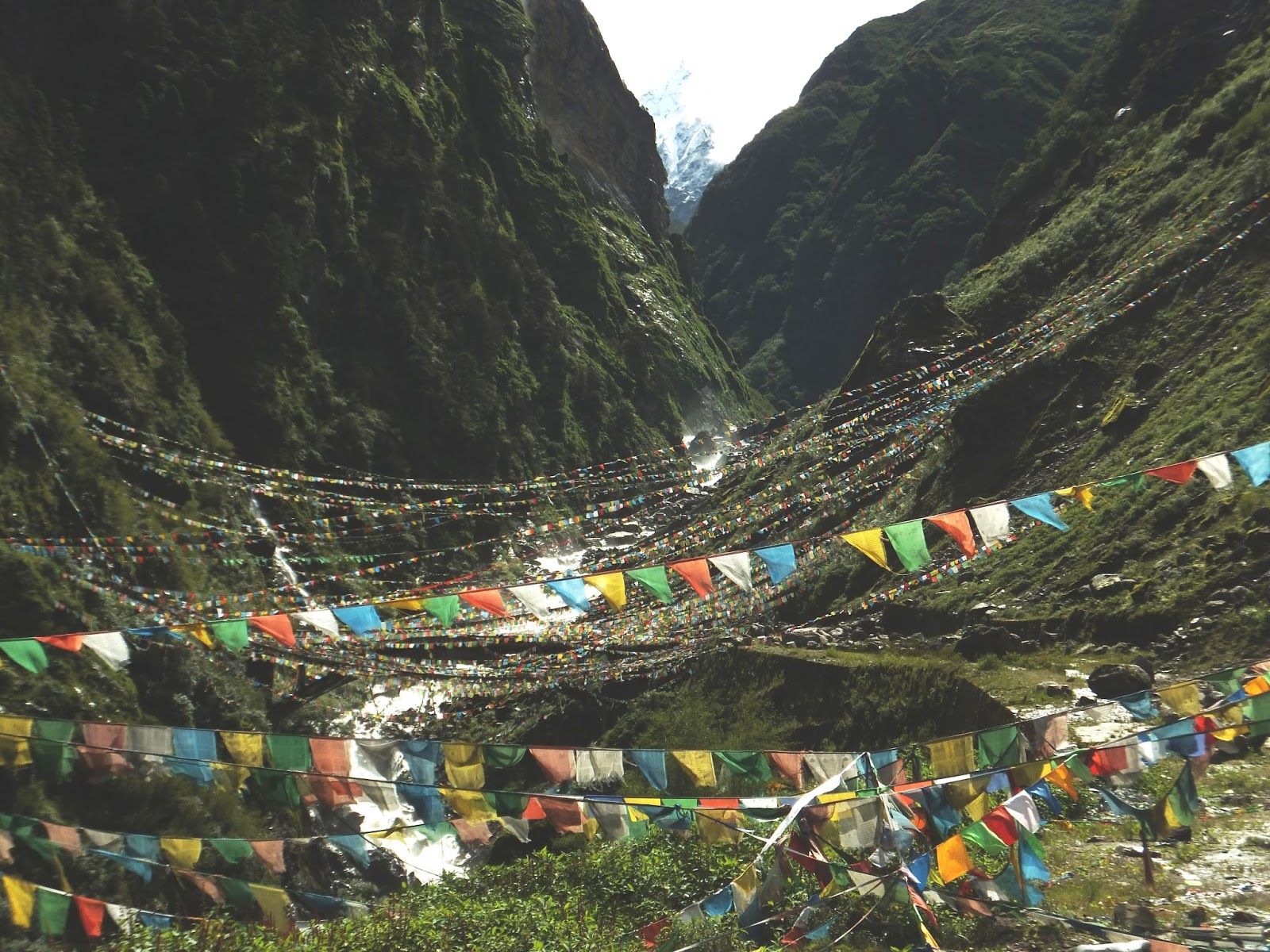
Yes, we dropped more than 2000 meters on our journey today through lush rain forest Zangmu is a one street border town clinging to the side of the mountain We'll leave the next part of the story (and how beautiful the rainy side of the Himalayas is) to Nepal. Here's one last picture to give you a hint.
As you travel toward Tibet, you see mile posts with the distance from Shanghai, but we think you'll be more interested in the distances from Grimshaw (Canada not Scotland) that Cal has been keeping for us since the beginning of the trip.
N 36.24.23 E 94.53.39 Altitude 2780 meters 9265 km from Grimshaw
The question In everybody's mind was "would we be allowed to enter this province/autonomous region/country?" The Calypso family met our Tibetan guide, Tsewang, in Golmud and with permits in hand and positive thoughts we started the journey south. We passed the first checkpoint just outside of town with no problems but a few km south we encountered road repairs (done by hand by crews of women and men) and two major military convoys - one coming from Lhasa and the other heading in our direction. Interesting fact - even the military trucks are decorated with ribbons and bows. It was slow going through the construction and our first bush camp was still north of Tibet.
| donkeys not deer |
| Jason making a concession to the temperatures by wearing a jumper with his flip flops and shorts (Lorri learning Brit/Aussie expressions) |
| Beautiful night skies at this altitude |
N 44.51.34 E 92.56.44 Altitude 4570 meters 9480 km from Grimshaw (altitude and animals)
We were all feeling the effects of altitude sickness - headaches, breathlessness, and nausea as well as a restless sleep. But we packed up camp and continued our journey along the Tibetan plateau. The land is starkly beautiful We've seen a bunch of interesting animals, too, as the road travels through very unpopulated highlands. Wild Tibetan donkeys (pretty brown colour and we mistook them for deer till we enlarged the photos), Himalayan deer and antelope, and cute little rodent things that we named Gregory (gerbil sized) and Henry (small rabbit sized) until our Tibetan guide realized what we were doing and said that Gregory was a Himalayan mole and Henry was a pica. I think we are entertaining him! And there are yaks everywhere (many decorated with prayer flags) - but they are domestic, apparently there are only a few wild ones and they stay at higher altitudes and away from people. Lou and Cal, with the occasional contribution from Nico, continue to see new birds. There were black redstarts, brown cheeked buntings, Himalayan griffons (who win the prize for coolest name), brown headed gulls, hoopies and a whole cast of others who remain nameless.
| Gregory |
Mid morning saw us stopping at the "welcome to Tibet" archway for a photo op. The police check a few km down the road took five hours while passports were checked and higher authorities were consulted. It makes you realize how unusual it is for a western group to travel overland into Tibet. While our guide spent the time in the office, we had lunch, did some pre-dinner prep, played a bit of basketball, entertained the locals and participated in a number of photo ops with officials and passing motorists. Permission was finally granted to continue, and after a quick supper and a very enthusiastic "woo hoo" Calypso and her family were officially welcomed to Tibet.
| Looks like an album cover. Tsewang, Steve, Cal, Jason,Dave, Bruce, Keith, Alicia |
| Teresa, Lou, Tina, Mikkel, Jordan and Mel |
| Setting up camp as dusk is falling. Mikkel and Dave on the roof. |
![]() |
| The iphone version, just the silouette |
| Sunset at almost 5000 meters |
| Nico's wee tent for the ladies was hastily taken down in the wee hours as the mother of all storms was sending lightening and winds to entertain us. |
N 32.44.48 E 91.52.27 Altitude 4963 meters 9735 km from Grimshaw (more altitude and a birthday)
Getting up in the dark to start a long drive to Lhasa, everybody worked to help each other pack up camp with conversations about the lightening storm that had passed through, the gorgeous sunset and who was dealing with what altitude symptoms. It was a quiet group that hit the truck, but some magic fairies (led by Mark our truck wallah) had found the breath to blow up balloons for Lorri's birthday. Lunch, and birthday cake, were had at a police check that included friendly yak, curious Gregories and the ever present visiting dog.
| Checking out an accident that happened as we passed it |
| Yurts and prayer flags Set up just like a pow wow circle in Northern Alberta |
N 39.39.20 E 91.07.50 Altitude 3677 meters 10089 km from Grimshaw (Lhasa, Buddhism and retail therapy)
After two looong driving days and high altitude bush camps we made it to the Yak hotel in Lhasa. Not a sleepy isolated Tibetan town by any means. The old town (and we are in it) comprises 4% of the city. The rest is bustling Chinese city like the others we have seen. Great comfortable beds, excellent wifi, included breakfast one of the best on our trip (real bacon) and a lovely restaurant next door. We are here for four nights, so lots of time to check out the sights.
| Prayer flags on the roof of our hotel |
| Two ladies visiting Traditional dresses and lovely hats |
| Mixing the old and the new. Hill trbesman with traditional hair and beads (coral, turquoise and/or amber) and western shirt and hat |
Top on the list of things to do was to visit the Jokang monastery, one of two UNESCO sites in Lhasa. Built in the 8th century, damaged and rebuilt numerous times over the centuries (most recently following the Cultural Revolution in the 1960s), our guide, Tsewang, used the tour to help us see the intertwining of history, politics and religion for the Tibetan people. Bruce put it so well (thanks Bruce for letting me paraphrase your words) that for us westerners, religion is something that we put on or take off at our convenience. For Tibetans, however, their religion defines their every action.
| These aren't the snow lions (aka Gregories) you will see at the Jokang temple |
1. When you go to the Jokang monastery, look up at the rafter poles around the second floor, or look down into the courtyard from the second floor. Every monastery has snow lions for good luck, but these ones are individually carved by some unknown artist. Like gargoyles in mediaeval European churches, these are all different, and it seems like a whole field of Gregories peering at you!
2. The Potalo palace has all sorts of restored glitz, but watch for the cabinet with hundreds of Buddha statues. Some of them are more than 1000 years old and all of them were carefully hidden by local people to protect them from destruction during the Cultural Revolution.
3. Sera monastery is absolutely worth a visit. The ride on the local bus there and back is prime people watching. It's noted for healing cranky babies and adults with mental illness - when we went through, a smiling monk insisted we needed blessing so we all left with black smudges on our noses!
| The smudgy nose crew |
| Sera Monastery dogs |
| Potala Palace from the People's Square |
| The ugly frowny figures, sometimes with flames are "protectors" aka good guys |
Lhasa wasn't all monasteries, it was also a great place to stroll the old town and people watch. The markets satisfied everybody's retail therapy needs. And it was hard to decide whether to eat Tibetan, Chinese, or fast food fusion (the word Dico's comes to mind).
![]() |
| Bandian - traditional married woman's apron. This is hand woven and hand dyed pure wool not the mass produced cotton or polyester for everyday |
![]() |
| If I could have figured out how to get this home... Yak skull artwork |
![]() |
| Prayer flags |
| Coffee break for the street cleaner |
N 28.54.43 E89.36.19 altitude 4037 meters 10208 km from Grimshaw
(Gyantsi, another birthday and a stunning conclusion to the Calypso World Cup Football Pool)
Next, it was off down the Friendship Highway. To get to Gyantsi, we drove narrow twisting roads through beautiful mountains. You could tell we were on the tourist track now, with busloads of Chinese tourists as fascinated by our little group as by the mountain scenery. And at each stop there were enterprising nomads showing off their animals or offering to sell trinkets.
| 5 yuan for a photo. This lady was using a drop spindle to spin wool as she was minding her cows |
| Lou checking out a "bow" (baby cow) |
| Alicia taking a photo of Lorri taking her 5 yuan photo |
| Nico and Bruce |
| Prayer flags on |
| Chinglish |
Of course there was another monastery. Watch for the very ugly/flaming Buddah figures- they are actually protectors, not bad guys. Also, take a walk toward the river and walk the back road. You can get some great photos of the monastery and the fort above it. Imagine, before the Cultural Revolution, that all the empty ground was full of buildings.
| This fort figures in the great game. |
T and T had time for a T (tattoo, that is). But the big social event was Wayne's birthday held at the Gyantsi Kitchen. It was a three white scarf set of birthday wishes and a good time had.
Before we left Gyantsi, we had one more important celebration. Starting in Kyrgyzstan and continuing through China and into Tibet, the Calypso family eagerly followed the World Cup Football. Each morning, our truck wallah, Mark, would post scores. Some of us were more excited to find out what were the categories of the day, some of us cared about our points. There were even an enterprising few who figured out how and where to watch the games live. But like all good things, it came to an end on the truck before leaving Gyantsi. Despite a last minute battle with Steve, Cal managed to hold onto his last place position and be crowned Chumpion. Top place and Champion of the World was never in doubt as Luke, with his excellent skills at playing the odds, had led from the beginning. But Jordan and Jason had been quietly creeping up the ranks. In the end, though, Jordan managed to outstrip the competition to become honored runner up.
N 29.16.23 E 88.53.04 altitude 3815 meters 10187 km from Grimshaw (Shigatze in the rain)
We were in Shigatze for three days to get permits to visit Mt. Everest base camp. Or maybe it was to get permission to travel to the Nepal border. Despite the frequent rain showers, we all managed to find something to do. For some, it was a chance to do a bit more retail therapy, for which Bruce gains the distinction of getting the most spectacular bit of jewelry (to go with the equally lovely ring in Lhasa). Some took advantage of China Post to send their treasures onward, while others found space in luggage. One last monastery, this one the home of the Pachem lama, even though he lives in Beijing. By this time, our guide Tsewang had gotten a feel for the group and was a bit more open on telling the slightly less politically correct but more interesting bits. Like the rumor about monks being bribed with tv in their cells, and... Interesting fact, the kora (pilgrim's walk) is up into the hill and is a great way to people watch, check out animals and see over the old town as you walk back into the market.
| Everywhere in Tibet you would find fabric or painted designs along the roof line. It is to remind people of their nomadic past. Many great quilty ideas. |
| Old not yet retouched designs |
a bit of rebellion here. any time you see snow lions in clouds in Tibet, it is referring to independence. |
the old paintings had their own elegance |
| Local sheep helping to eat the offerings of grain The messages on the rocks were carved/painted and carried to the mountain |
| Taking photos of tourists taking photos |
| And a local goat |
N 28.34.10 E 87.05.06 altitude 4359 meters (Somewhere near Mt Everest)
It was another long day driving, including a most interesting several hours being part of a major "truck got stuck" incident. Apparently this section gets washed out every spring and then repaired every summer. What made it worse was that the rain we had had in Shigatze had been three days of snow - which brings home how high we are and how brief summer is on the Tibetan plateau. Hint from Lorri - check out Corb Lund's video "The Truck Got Stuck"" to get the feel for the situation. We pulled into the national park with just enough daylight to pitch tents and eat a "home cooked Chinese meal" courtesy of our Chinese guide, Daniel, and cook group one.
| Cow with decorations |
| And here he is! Long telephoto from about 50 km away |
| The best part was the mini bus with hill tribes people. They all got out, figured out how to attach a rope and started pulling. Ladies as well as men. It takes a community... |
N 28.10.10 E 86.50.25 altitude 4991 meters (Everest Base Camp - we made it!!)
We started our day getting tickets to the base camp where we had a perfect early morning view of Mt. Qomolangma himself (for Tibetans, the mountain is definitely a he). Then we started up the road to the tent village we would stay in for the night. Up, up, up then down, down, down as we moved from one valley to the next. Great scenery, local nomads and their animals. Finally just after lunch, we arrived at the tent village where tourists must stay. Vastly overcrowded and under serviced, but the Calypso family made the best of the situation (and used our well practiced bush wee skills), because for some of us this was the highlight of the trip.
| Everest is the middle peak, some is being a little shy (cloud covered) |
It's only a 3 - 4 km walk and less than 200 meter elevation gain but at this altitude, that still means lots of stopping to catch our breath. Some of us chose to enjoy the view from the tents, some of us went up and down fairly quickly (content to see the arch, snap a photo or two) but a few hardy souls communed with the mountain most of the afternoon. Although the mountain had been exceedingly shy and cloud covered all day, later in the evening the clouds lifted giving great views. Interesting fact, the river that is flowing from Everest is a tributary of the Yellow River.
![]() |
| Behind that cloud is Mt. Qomolangma himself |
Thanks to the weather gods for sending the rains when we were in Shigatze and the blue skies when we visited Everest.
N 28.21.28 E 86.03.44 altitude 4215 meters (Moving down. All things must end - last bush camp and a final Calypso adventure)
Next morning, out the way we came then south on the Friendship Highway. Still the stark mountain passes but we were dropping in altitude. We started to see cows instead of yaks and some vegetation. The streams we crossed are flowing in our direction. The crew and our guides started to talk about finding a really nice spot for our last bush camp. Ever. And perhaps a bit of a party. A lovely green spot by a river was found. Unfortunately, Calypso had other ideas and got stuck up to her front axel in the mud (repeat "the Truck got Stuck" if you wish). After hours of digging determination and a lot of creative "truck unstuck" solutions, we turned in with prayers that tomorrow would be a better day. And it was. With sand mats, rocks in the right places, and an audience of the local nomads, Calypso inched her way back onto the road and we were off toward the Nepal border town of Zangmu.
N 27.59.18 E 85.58.56 altitude 2190 meters 10392 km from Grimshaw
Yes, we dropped more than 2000 meters on our journey today through lush rain forest Zangmu is a one street border town clinging to the side of the mountain We'll leave the next part of the story (and how beautiful the rainy side of the Himalayas is) to Nepal. Here's one last picture to give you a hint.
Subscribe to:
Comments (Atom)