11 April 2014. Istanbul
(Silk carpet hand knotted near Istanbul and a wool carpet hand knotted in the
Kurdish area of Turkey). It was a great afternoon experience – from being escorted
through the Blue Mosque and over to the uncle’s shop to the final purchase and
hope that it was actually going to get back to Canada (it did, indeed all our
parcels eventually made it home). Not
signed by the artist, but a quilt square has a greeting in both Turkish (from
the owner) and in Kurdish (from his assistant).

21 April 2014. Pamukale, Turkey
A commercial scarf with hand tatted edging was sold to me by
the lady who made it. She was delighted
to be part of a group photo.

6 May 2014. Tblisi,
Georgia. Hand woven and hand embroidered table topper. Across the street, postcards from the
artist’s wife.


20 May 2014. Baku,
Azerbaijan. A hand woven lamb’s wool scarf with paisley flames.

Uzbekistan. A treasure of fabric art.
The Aral Sea has basically been drained to grow cotton for the Russian
markets and silkworms grown in family homes give a different meaning to
farming.
27 May 2015. Kiva. A square hand embroidered with silk carpet
threads reminds me of bargaining for silk threads that have been incorporated
in my travel quilt and a photo of the shop manager. I also purchased a dress
hand made by the shopkeeper. The fabric
was cotton (from the Fergana Valley) but woven and hand printed batik in
Kiva. It got a lot of wear as we
traveled because it was so cool and didn’t need ironing. It was fascinating reading “A Carpet Ride to
Kiva” about the development of the carpet coop.


30 May 2015 Bukhara. Hand made scissors and knives of Damascus steel, Suzani embroidery and Ikat scarves.
Fantastic conversations with the artists. If they had accepted mastercard, or if I had
had more USD, I would have purchased a hand felted scarf that would have
fetched hundreds of dollars in North America.


I had a lovely time deciding which one of the hundreds of
Suzani embroidery panels to purchase.
The shopkeeper explained that she was an instructor at the local college
teaching others about this traditional skill.
She sold her work as well as that of her students. I knew how much money I had in USD to spend
and explained that I would prefer a high quality small item rather than
something much bigger that would be difficult to carry. I loved this one when I first saw it; the off
white colour and the warm rusts and earth colours appealed much more to
me. She was clearly delighted as I had
chosen one of her embroideries AND it was her first sale of the day. She took my USD and patted them on all the
other items in the shop to give them luck – a process which I saw time and time
again through our travels in Asia.
The fabric is Acras which is a blend of silk and cotton
threads which were grown in the Fergana Valley of Uzbekistan. The fabric was woven in the Bukhara
area. The design was hand stitched with
silk thread. If you look carefully at the
fabric, you can see faint pencil marks to guide the placement, but the entire
design was stitched without a pattern.
After the embroidery is finished, the fabric is boiled in onion and
walnut water to give it the lovely warm colour. The outside border design is peppers – to ward off the evil
eye – and the inside design is also traditional.
When I got home, I added a backing to protect the backing
stitches. What better to use than a
piece of silk fabric I had purchased at the Silk Production Factory we visited
in the Fergana Valley. The fabric is
silk ikat created using the traditional methods from growing the silkworms to
weaving the fabric. Here are some photos of the process.

 |
| Doesn't this look like an artsy something or other? It's actually the warp threads after their first dying and now tied for the next colour. |
 |
| This lady was dancing on seven pedals as she wove the fabric. |
 |
| If I thought I could have carried this, I would have tried to convince the coop to let me purchase this hanging on an outside door. Silk threads, cocoons, and a rough piece of board. |
18 Jun 2014. Kyrgyzstan. Hand felted items. Getting to create my own hand felted
fabric. Begaim finding patterns for
traditional Kyrgyz embroidery and explaining the symbolism. Realizing that the process and the designs
are also used in western quilting and embroidery, no doubt traded along the
silk road.


1 July 2014. Magao Caves
(Dunhuang), China. Apsaras and paintings on silk. After exploring the Magao caves and not being
able to take photos, it was actually a delight to arrive at the “souvenir” shop
at the exit gate. Books, high quality
sculptures, fabrics and these original paintings on silk were all available for
purchase. Not copies, but “in the style of”.
The artist has permission to create paintings of apsaras, but they are
from his own creativity. I chose to
purchase an original on silk but could also have bought prints or postcards.

26 July 2014. Katmandu,
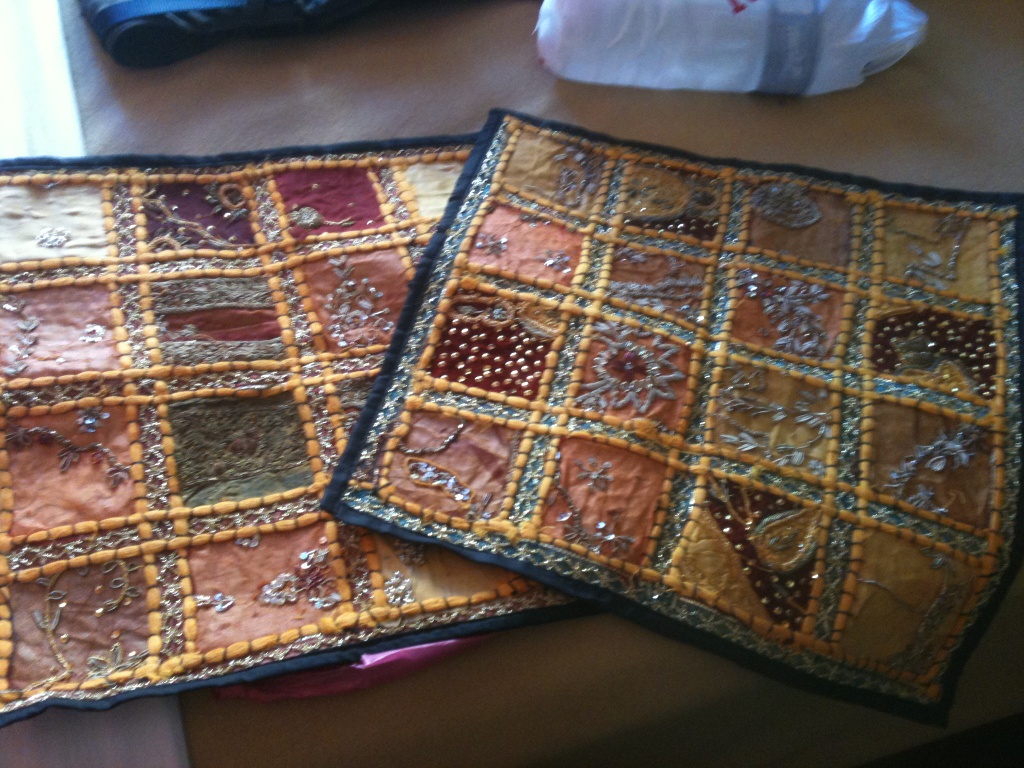
Nepal. Hand embroidered pillow
cases. From over the border in Northern
India in the shop owner’s village.
Borders are an iffy science.
19 Aug 2014. Darjeeling,
West Bengal India. Ava Devi’s silk
embroidery from the 1930s. Originals for
viewing but not for sale. Watching the
villagers create hand painted silk sari fabric as we drove from Mashuribad to
Kolkata, then purchasing fabric from the co-op. Touring the Idol Makers market
where sculptures were hand created for festivals.
 |
| Man of the East. Hand stitched silk threads on black fabric. |

24 Aug 2014. Chaing
Mai, Thailand. Hope, hand carved by a
local artisan to support the Elephant Nature Park and hand made paper art card,
also with elephants.

30 Aug 2014. Luang
Probang, Laos. Op Pop Tok. Hand dyed and hand woven silk items. The master artist who helped me create my own
work of lemongrass and teak. Learning
just enough to appreciate the skill and patience to create the multi coloured
scarf I purchased. Night market where I
bought Hmong embroidered pillowcases (and was the first sale of the day, same
routine as in Uzbekistan) and hand painting on mulberry paper from the artist’s
wife.
 |
| Hmong traditional pattern. Reverse applique. |


This image of the monks in their yellow robes (traditionally
dyed with marigolds) was everywhere. In
Laos, most boys are sent to a monastery for a few years to get an education
before they are considered adults, and the monks are very much a presence in
the communities with their morning alms sessions (people provide food for the
monks and in return receive a blessing for the day).
Luang Probang is a very tourist oriented city and this image
was everywhere – on posters, notecards, postcards and even tshirts. However, at the night market, I found this
one stall where all the paintings were handmade and a little unique. The shopkeeper explained that her husband did
all the paintings. The paper was handmade
sa (mulberry) which traditionally had been used for all important
documents. The background is handwritten
calligraphy (by the artist) and is the daily prayers that the monks chant as
they walk.
6 September 2014. Hue,
Vietnam. Our hotel in Hue had dozens of
these silk thread paintings on the walls.
They were all for sale. The story
is that this is a traditional embroidery skill in the local villages and that a
company (actually one fellow) had bought them from villagers on consignment for
sale in the city. He then sold them all
to the hotel before immigrating to America.


Tranh, who was the daughter of the owners and helped out on
her days off, had actually spent a year as an exchange student in Port
Alberni. She helped us decide which one
we wanted and knew how to get a shipping tube (from a friend’s shop down the
alley) and figure out how much it would cost to mail. Again, the cost was a pittance of what I
would have paid in North America.
18 September 2014. Preah Khan (Siem Reip), Cambodia. Temple rubbing on rice paper from the artist,
Sao (Saturday).
This young man was selling temple rubbings just outside the
Preah Khan temple in Ankhor Wat. He
explained that the paper was traditional handmade rice paper and that he had
learned the skill of rubbing from his father and grandfather. First the paper is placed on the frescoes and
the shape rubbed into the paper. Back at
the shop, it is coloured, either with the traditional charcoal mixture (as this
one is) or with modern acrylic paints to give colour.

I had actually seen this fresco in Ankhor Wat. It shows daily life around the temple. The artist’s name was Sao, which translates
into Saturday. No, he wasn’t born on
Saturday, but his dad’s name was Friday.
He autographed the back of this rubbing after a lot of persuasion. I had a great time bargaining for this, and
then Cal quietly gave Sao his original asking price which was probably about $
15.00. A great experience.
15 Feb 2015. Bali and
Lombok, Indonesia. Creating a hand
painted batik panel and then finding hand stamped sarong fabric with
traditional Bali symbols. Buying hand
painted batik postcards from a street gypsy whose brother had painted
them. Hand carved wooden figures made by
the shopkeeper’s family in Mas. Again,
we blessed the shop by being the first sale of the day. Visiting the many handcraft villages on
Lombok; some providing very high quality items, others less so.

 |
| "President's stove" Pot on the top with a fire in the center. A political commentary on the increase in the cost of fuel. |

 |
| These scarves were very simple and loose woven of thick cotton thread that was imported from Jakarta. |
 |
| While this lady showed us how to weave the bamboo containers, her husband quickly created simple rings for the ladies in our group. |
 |
| One of the cards I purchased from a street gypsy. Hand painted by his brother. |
 |
| My much simpler hand painted batik. With a lot of help from the master. |
13 Mar 2015. Malaysia. Trying to find hand crafted items was
impossible in the markets as everything was mass produced in Kuala Lumpur. Finally finding the local shop that bought
items from villagers on consignment.
Hand painted silk scarf and a hand painted batik picture as well as a
hand strung bead bracelet from a local tribe.
 |
| Hope has made himself at home with the rest of my elephants. |

Taking the four items I wanted to be framed to Claire was a
joy as well. We talked about where they
had come from and the memories attached.
How I had paid (what was for me) a pittance and for the artist was an
honourable way to bring money to the family.
The experience of asking for autographs to honour the art. Remembering the many other items from near
and far that she had framed through the years.
Honouring Claire’s art of framing by trusting that the beauty of the
pieces I gave her would be enhanced by her work. No questions asked. No invoice signed. No deposit necessary.


Travel art in the true sense of the word. To the artists I met, thank you for enriching my experience
of your country.


